My path to becoming an expert
on AI risks and AI safety

When people look at my CV, the reaction is usually: "Now that's quite the mix!" And they are absolutely right: sociology, television, newspapers, journalism, content marketing, graphic design, political education in prison, the public sector, podcasting, content creation and keynote speaking. At first glance it looks like a random pile. But there is one common thread running through every stage of my education and my career. And that is preparing and communicating complex information.

I love learning new things and passing that knowledge on to an audience in the clearest and most visually engaging way I can. Over the years I have focused this skill more and more on a field that fascinates me in particular: the intersection of technology and society. And because there are still not enough critical perspectives on AI on social media, I started talking about it publicly. Almost 100 videos and numerous videos on AI news and studies later, this is where I am today. It has been a long road to get here, though. You can read what it looked like below.

Portrait of Niklas Titgemeyer 125,000 followers
Corridor with barred doors in a prison, a reference to my teaching work in the prison system

How it all started

I started out in 2016 studying social sciences to become a teacher. For my master's degree I then switched to sociology and completed my degree at the Cluster of Excellence for Religion and Politics in Münster. During that time I began to engage intensively with the intersection of technology and society. But all of this was still before the release of ChatGPT, Gemini, Claude and other chatbots. My specialisation in artificial intelligence and its risks and consequences only came later, through various training courses and my own work in AI science communication.

Alongside my studies I worked in journalism for many years, both in the television newsroom of the public broadcaster WDR and as a freelance journalist for the regional daily Neue Westfälische. That work and those experiences have shaped me profoundly and that still shows today. Which is why you will find the sources I used for every one of my videos on my website.

I then went on to work in political education for an NGO. Among other things, I talked with prisoners about life and participation in a democracy and about media literacy, in high-security facilities as well as in the juvenile system.

Next I moved into the public sector, where I have been working as a specialist in radicalisation prevention and democracy promotion ever since, delivering political adult education inside the city administration, in schools, at conferences and at other events. That includes talks and workshops on topics such as radicalisation, extremism and disinformation.

The technology that
changed everything

Ever since ChatGPT was released I have been fascinated by this technology. What it makes possible, but also the limitations and risks that come with it, made me want to learn as much about this tool as I possibly could. Since then I have specialised in chatbots, not only through years of hands-on use, but also through countless training courses and by reading a great many studies. Because I wanted to understand where the limits and the risks of these technologies lie, so that we can learn to use them responsibly and sustainably. Both as individuals and as a society as a whole.

One question remained, though: how do I combine the skills I already have in a way that turns this knowledge into a career and at the same time helps make AI literacy and media education accessible to a broad audience? And the answer, I concluded, was to move into science communication and public outreach on social media. That gave me a plan. But putting it into practice was a very different (and lengthy) matter.

Stepping into the public eye

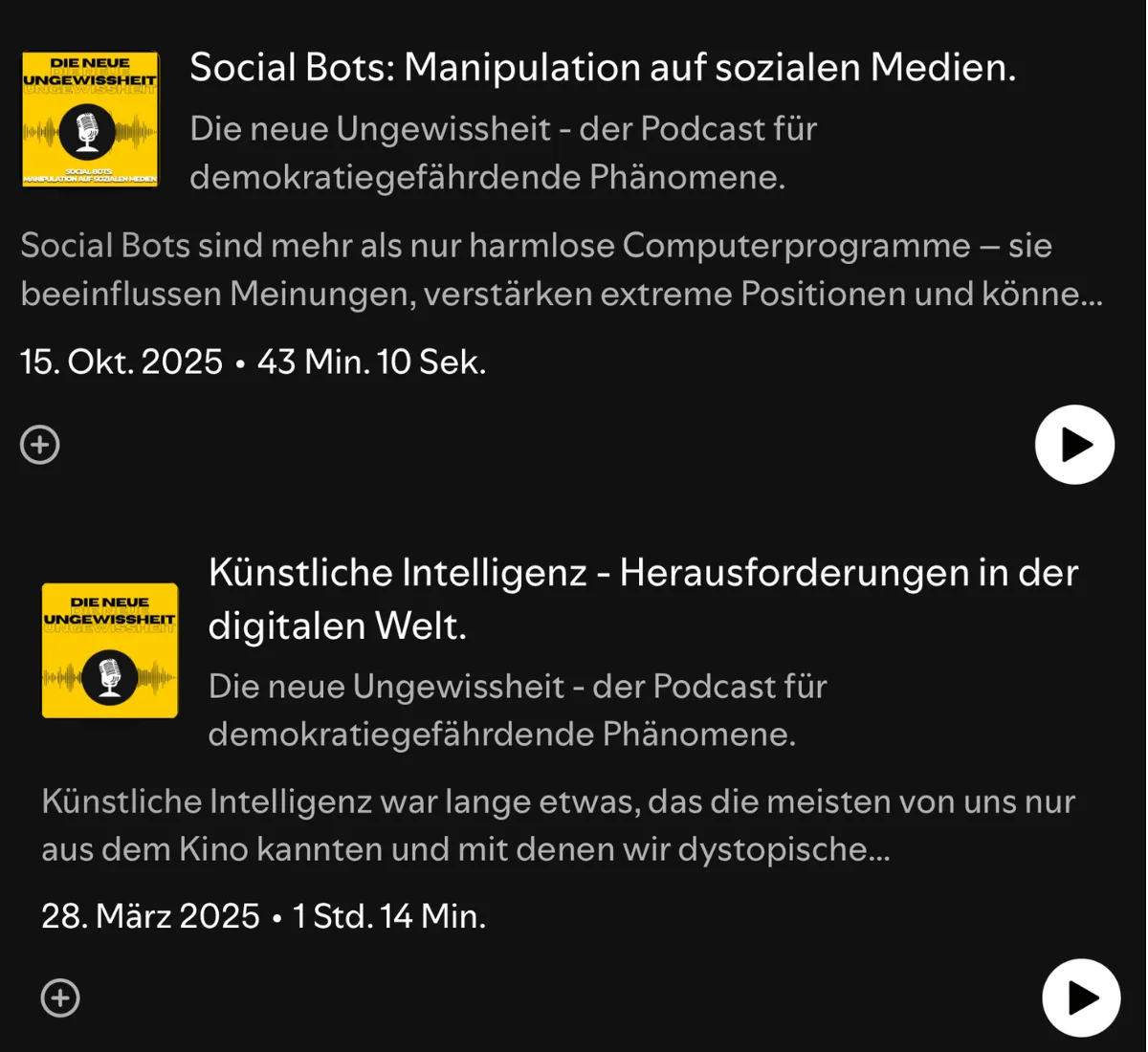
Two episodes of my podcast "Die neue Ungewissheit" on social bots and artificial intelligence
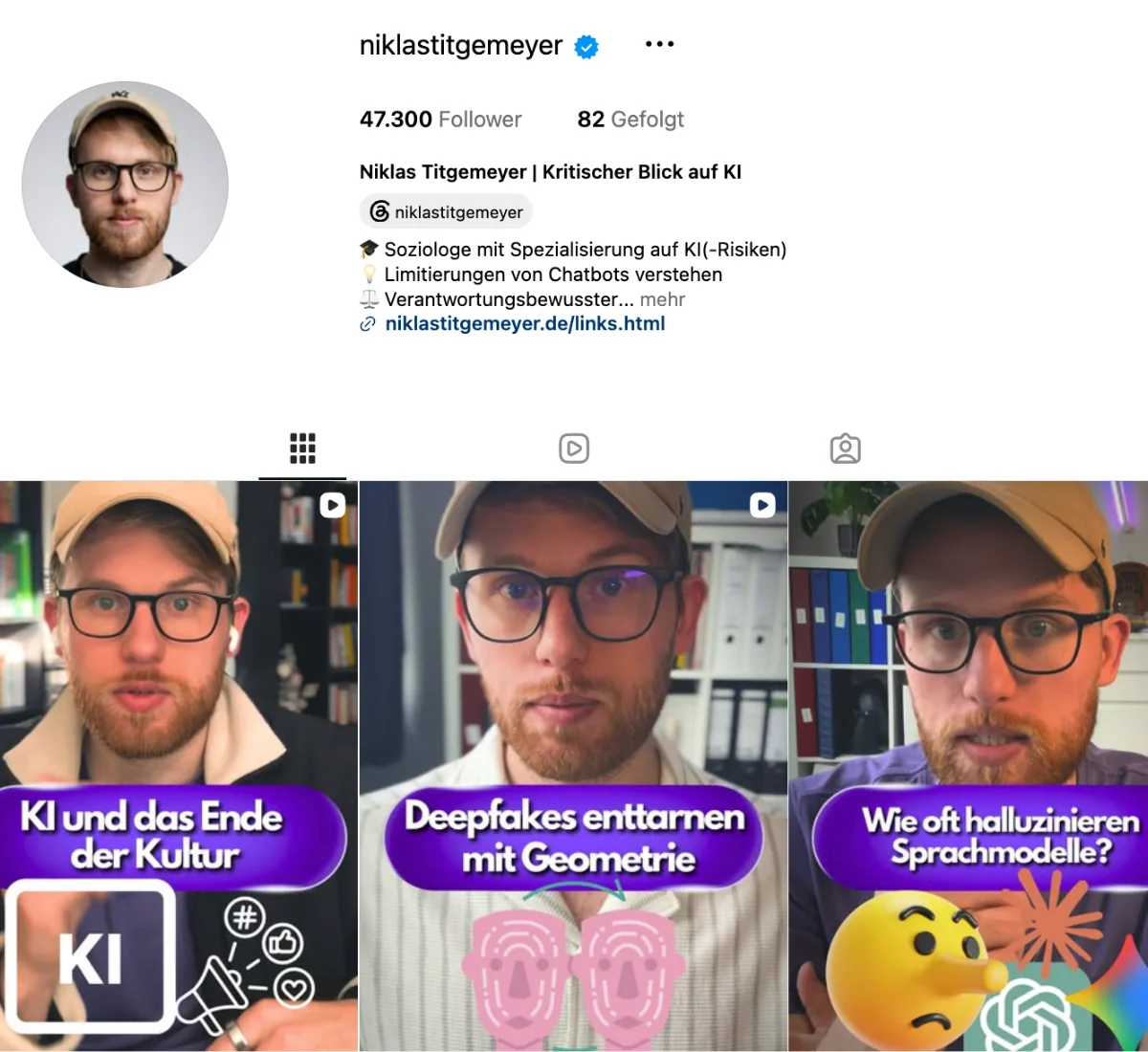
My Instagram channel with 47,300 followers and videos on deepfakes, hallucinations and AI

I began my journey into science communication with a podcast on phenomena that threaten democracy. In it I examined the work of researchers who study phenomena at the intersection of technology and society. For example "social bots", radicalisation through social media or "artificial intelligence" in general. That got me started. But I still had a long way to go.

In 2025 I stepped in front of the camera for the first time and published long-form videos about AI on YouTube. There I examined the work of researchers and published my own analyses and essays on topics like social bots and deepfakes.

Shortly afterwards, though, I switched to short-form video and started talking on Instagram and other platforms about the risks and limitations of chatbots and about using AI responsibly. And that was when I had my first taste of "real" success. Videos with hundreds of thousands or even millions of views, and by now more than 125,000 followers across platforms.

That is why I decided to put more and more time and energy into this work, to build a professional web presence, to expand my content production to LinkedIn and to give professional keynotes. Because in my view there is still too little educational work on AI safety and AI risks in Germany. In other words, the very topics I work on every day.

Artificial intelligence is already an incredibly helpful and, yes, in some respects definitely intelligent technology today. There is no doubt about that. But as is so often the case, it brings a whole set of problems with it. We need to discuss those problems. We need to build skills, engage with the weaknesses and make the younger generation aware of how to handle all of this properly. But most importantly, we need to make sure that, as a society, we discuss the general problems that we are going to face with the arrival of AGI or even artificial superintelligence.

Because mastering a technology and using it responsibly means first and foremost understanding what you should not use it for. That is exactly where my work sits. If you would like to know more, feel free to use one of the buttons below, whether you are looking for more information or want to get in touch with me. I look forward to hearing from you. And for anyone who wants the full detail: my complete CV is right below.

Keynote details Request a keynote

These four principles
guide my work

Principle 1

A critical view of society

Artificial intelligence undoubtedly holds possibilities beyond our imagination and will change our society like no technology before it. But many of these developments also come with enormous dangers: deepfakes, a lack of AI literacy combined with a high level of trust, automation bias, misinformation, unemployment, the control problem of artificial superintelligence and much more. As a sociologist (MA), it is important to me to take a critical look at these developments and always to consider what they mean for society, democracy and the individual.

Principle 2

Real value

We have all sat through enough training sessions or online courses and thought afterwards: great, I didn’t really take anything away from that. Social media in particular already has enough brainrot that harms our brains and our health. That is why I measure my content by whether it offers real value to my audience: either news value or concrete practical use.

Principle 3

Responsibility

There are already (too) many content creators in the AI space who welcome every technological development unconditionally and jump on every bandwagon without thinking about the content or the technology behind it. All that matters is the clicks. Although social media rarely works entirely without polemic because of its algorithms and dynamics, it is important to strike a healthy balance when writing scripts. It is even more important that every video and every topic is thoroughly researched and thought through. Because once a false report has gone viral, no correction in the world will reach an audience of the same size.

Principle 4

Transparency

Transparency goes hand in hand with working responsibly on social media. Especially in fast-moving formats such as short-form videos, where anyone can claim anything, I think it is important that everything you claim can be traced and verified. That is why this website lists the sources for every video I post on social media, freely accessible to everyone.

My CV in detail

M. A.
Sociology
+0
Followers across platforms
+0 years
in journalism (TV & newspaper)
+0 years
working with AI models
  1. 09/2025 – today

    Continuing education in AI

    Professional development ongoing

    • Harvard: The science and implications of generative AI (free online course)
    • Responsible AI: A Non-Technical Guide for Managers (Udemy)
    • LLM Concepts Deep Dive: Conceptual Mastery for Developers (Udemy)
    • Intro to Large Language Models (LLMs) (Udemy)
    • Foundations in Responsible AI & AI Ethics (Udemy)
    • The AI Ethics Course 2026: Work with AI Responsibly (Udemy)
    • AI Fluency: Framework & Foundations (Anthropic)
    • Introduction to Subagents (Anthropic)
  2. 02/2025 – today

    Video content creation on AI and digital topics

    Self-employed alongside main role

    Scriptwriting plus academic and journalistic research. Video editing, audio, graphic, sound and motion design, including lighting and sound engineering. Market and trend analysis for content strategy, with a detailed understanding of what drives reach on YouTube, LinkedIn, Instagram and TikTok.

  3. 08/2024 – 01/2026

    Podcast "Die neue Ungewissheit"

    Audio content creation alongside main role

    A podcast on phenomena that threaten democracy. Journalistic preparation of topics, writing interview guides, conducting interviews, and building and maintaining contacts with experts and institutions.

  4. 04/2024 – today

    Specialist in radicalisation prevention & democracy promotion

    City of Wolfsburg main role, full time

    Managing director of the "Partnership for Democracy Wolfsburg", including budget planning and funding applications. Case management in the field of extremism, including threat assessment and liaison with security authorities. Designing and delivering workshops and training on extremism, radicalisation and anti-democratic movements. Also the point of contact for AI within the youth welfare office.

  5. 12/2023 – 04/2024

    Teacher in political education

    Brackwede & Hameln prisons / IBZ

    Integration training for foreign nationals in the prison system, focused on democracy promotion and deradicalisation (contract via IBZ Bielefeld).

  6. 09/2023 – 12/2023

    Internship in political education

    International Meeting Centre Friedenshaus (IBZ)

    Organising talks and expert conferences, designing and delivering lessons.

  7. 10/2020 – 02/2023

    Master of Arts in Sociology

    University of Münster degree

    Final grade 1.7 (German scale, 1.0 is best), at the Cluster of Excellence "Religion and Politics". Master's thesis "Conspiracy Theories and Identity" (grade 1.7). Top 15 in the essay competition of the German Sociological Association, published in the 2022 anthology.

  8. 08/2020 – 09/2020

    Intern with Kerstin Griese (SPD)

    German Bundestag

    Working for the Parliamentary State Secretary at the Federal Ministry of Labour and Social Affairs: research on social policy topics, preparing briefing dossiers and speeches.

  9. 06/2020 – 04/2021

    Working student at a content marketing agency

    Commandante Berlin

    Writing content, public relations and event organisation.

  10. 10/2019 – 04/2023

    Freelance journalist

    Neue Westfälische, German daily newspaper

    Writing long-form reporting for the Bielefeld local desk.

  11. 01/2019 – 08/2019

    Working student in the newsroom

    WDR Bielefeld, German public broadcaster

    Organising and planning the daily news programme, plus research work.

  12. 10/2016 – 09/2020

    Bachelor of Arts

    University of Bielefeld degree

    Major in social sciences, minors in sport science and education. Original career goal: teaching at secondary schools. Focus areas included radicalisation, extremism, conspiracy theories and democracy.

Want this perspective on your stage?

Whether it is a keynote, awareness training or a first conversation: write to me and we will find the right format.